
.jpg)
Written by:
Pkwy Moving & Storage Team
Published:
September 30, 2026
Learn how to break a couch apart safely, tool by tool, whether you're disposing of an old sofa or squeezing one through a doorway on moving day.
Breaking a couch apart comes down to finding its hidden fasteners, cutting away the fabric skin, and working piece by piece from the frame outward instead of hacking at it randomly. Most couches aren't one solid object, they're a wood or metal frame wrapped in foam, batting, and upholstery, held together with screws, staples, and a handful of dowels. Here's how to take one apart cleanly, whether the goal is curbside disposal, fitting it through a stubborn doorway, or just making it lighter to carry.
The two most common reasons are disposal and access. An old sofa headed for the trash or a donation drop-off often needs to be broken down because most haulers and dumps won't take a full-size couch in one piece, or charge more for it. On the access side, a couch that won't clear a stairwell, hallway turn, or narrow doorway sometimes has to be partially disassembled to get through at all.
Knowing which situation you're in changes how far you take it. Disposal usually means full teardown to frame pieces and separated foam. A tight doorway usually just means removing the legs, arms, or a back cushion rail, the minimum needed to shave a few inches off the width.
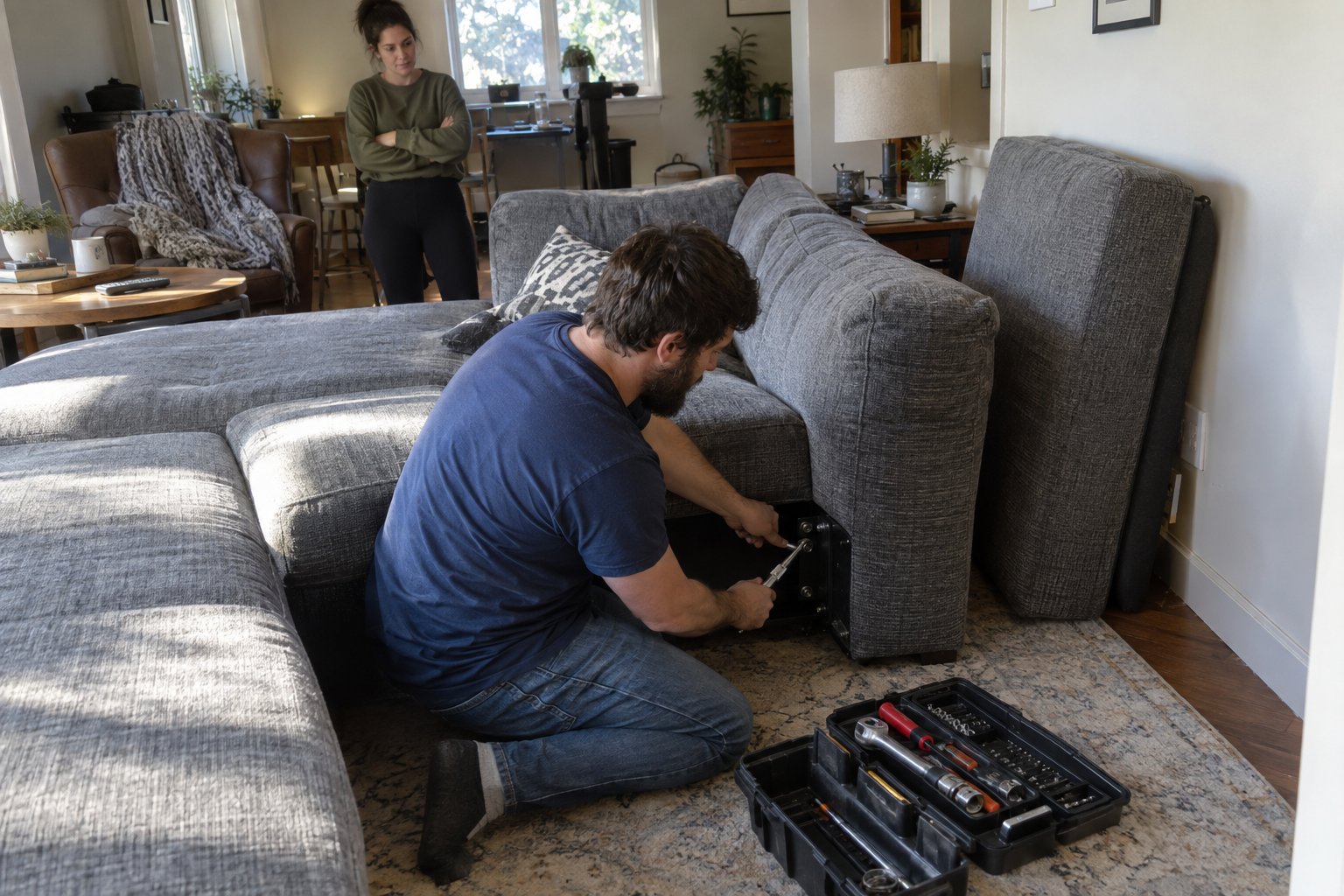
A cordless drill or screwdriver, a flathead pry bar, pliers, and a sharp utility knife handle almost every couch. Add a reciprocating saw or hand saw if you're planning to cut through the wood frame itself rather than just unbolting it.
Work gloves are worth putting on before you start. Old staples and splintered particleboard are the most common way people get cut during this job, not the saw.
Start from the outside in: remove legs and cushions first, then strip the upholstery, then separate the frame at its joints. Working in that order keeps the piece stable and lets you see the fasteners before you're fighting through fabric to reach them.
For a sectional, repeat this per section rather than trying to disconnect the sections and disassemble the whole thing at once. Sectionals are usually joined with simple locking brackets or clips underneath where the pieces meet, and separating those first turns one large job into several manageable ones.
Once a couch is broken into frame pieces, foam, and fabric, most curbside bulk pickup services and transfer stations will take it, though rules vary by city and hauler, so it's worth checking ahead rather than assuming. Foam and fabric sometimes need to go in with regular trash rather than bulk pickup, since some programs only take rigid materials.
If the couch is still in decent shape, it may be worth trying to sell or donate it whole before you start cutting into it. Disassembly is a one-way decision. If you're clearing out a couch along with other bulky items during a move or downsizing project, a junk removal service can often take the whole load at once, which saves the disposal step entirely.
Solid wood frames can sometimes go out with yard waste or be repurposed for small builds, while particleboard and most metal frames need to go with general bulk trash or a scrap metal recycler. This is another reason to check your city's bulk pickup rules before disassembly, some programs sort by material and reject mixed loads.
If the couch just needs to survive a move to a new home, don't disassemble it further than removing the legs unless a doorway, stairwell, or elevator genuinely won't clear it. A couch loses structural integrity every time a joint is cut or a panel is stripped, and that's not something you want to discover halfway through a move you're keeping the furniture for.
Measure the couch and the tightest point it needs to pass through before deciding. Diagonal tilting and removing doors from their hinges solves more clearance problems than people expect, often without touching the couch at all. If you do need to break it down for the move itself, a crew experienced with specialty moving for bulky, irregular pieces can help make sure a stripped couch frame is handled and loaded so nothing gets damaged along the way.
A couch rarely leaves alone. If you're breaking one down because it isn't coming with you, it's usually part of a larger decision about what to keep, sell, or toss before the move. Sorting that out earlier rather than the week of the move keeps the disassembly job from turning into a rushed, last-minute scramble. Our guide on downsizing before a move walks through how to decide what earns a spot in your next home, which is worth doing before you take a saw to anything.
If you're moving in the Dallas-Fort Worth area and want the whole process handled rather than running disassembly, disposal, and packing as three separate projects, our Plano movers team can walk through what to keep, what to break down, and what to leave behind. If disposal, not disassembly, is the real bottleneck, it's worth requesting a quote to see whether a full-service move can also handle hauling away what you're leaving behind. Get a moving quote and ask about junk removal add-ons before you start pulling staples.
Not always, but many bulk trash pickups and transfer stations charge more for a whole couch or refuse it outright. Breaking it into frame pieces, foam, and fabric usually makes it acceptable for standard bulk pickup, though rules vary by city.
Older or cheaper couches are often joined with glued dowels instead of screws. Once the upholstery is stripped, look for round wood pegs at the joints and cut close to them with a saw rather than forcing the joint apart, which can crack the wood.
If you want to reuse or donate the fabric, cut along the seams rather than through the panels themselves, since seams are usually stitched, not stapled, and separate more cleanly.
Removing the legs alone solves most doorway clearance problems and takes a few minutes with a drill. Only move to removing arms or back panels if the couch still doesn't clear after the legs are off and you've tried tilting it diagonally.
Disassembling implies keeping the parts intact and reusable, unscrewing rather than cutting. Breaking a couch apart for disposal is less careful by design, since the goal is smaller pieces that fit in a bin, not a couch you could reassemble later.
Moving in Celina or the DFW area? PKWY Moving & Storage handles local, residential, commercial, and long-distance moves. Get your free quote today.

.webp)
%20(1).png)
.webp)
%20(1).png)